Saturday, March 21, 2009

Village Wedding

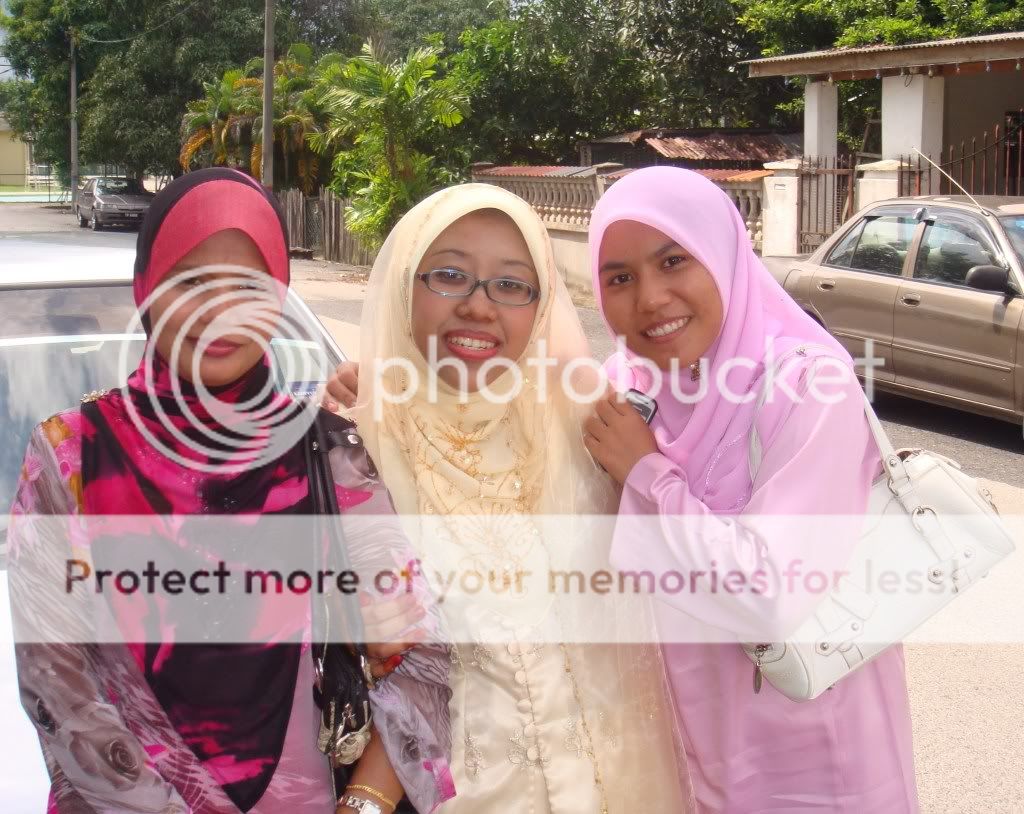
I went to a village wedding yesterday. A female colleague from the finance department married a former classmate from our college. They had studied together four years ago.

Riding my motorcycle northward, along the coastal road, it felt good to get out of town and out of my normal routine. Although the town in which the wedding kenduri was held was small, I still got lost and ended up traversing the entire downtown section before locating a landmark.

Malay weddings are held over several days, and in different locations. There are several specific steps, including an investigation (is she available?), an engagement (tunang) discussion that includes deciding upon the marriage fee (mas kahwin) and amount of gifts to be exchanged (hantaran). Rings are also exchanged around this time (tukar cincin). After the engagement period has run its course (several months to several years), there are two formal events, called the akad nikah (solemnisation of vows) and a bersanding (couple sits "in-state").

Finally, friends, family and neighbors are invited to one of two kenduris, held at each of the family houses: i.e., the groom's parent's place and the bride's parent's home. Usually these are held on different weekends, but this particular couple (shown above), scheduled their kenduris in the same week, on a Wednesday and Friday. Basically, a family hires a caterer, or gets assistance from neighbors, to prepare a wedding feast which guests share underneath a canopy, out of the searing sun. The couple sit indoors where mostly women go in and out, offering their congratulations to the youngsters.

Outside, I accepted the greetings of the bride's father and identified with his giving away his daughter since I had done the same several years ago. It is also good manners to press some money into his palm at this time, to help offset wedding costs.

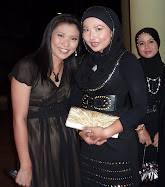
Some female colleagues made the trek to the bride's home on Wednesday, whilst another group (of females) went on Friday, taking only a half day of work.

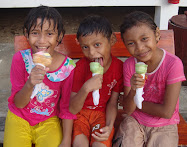
I linked up with the family of one colleague since I didn't want to go alone. The colleague brought a sister and brother-in-law with. Each has a daughter born in the same year and same month, but they could almost be twins (seen on the right).

Later, I watched the four children while the parents shopped in the small downtown. These village kids were quite content to hang onto a coin-operated ride even when my small change ran out and the machine went dead.

The Malay village (kampung) is a special place and has a deep root within the Malay psyche. Although I am sure that it could seem dull after a while, Malays reflect back to their village-upbringing as a time when life seemed simpler, and perhaps more content.

Thursday, March 12, 2009

Who is Important, Part 2

The Organisational Chart

One of the first things that a commitee will do when given a task is to lay out an organisational chart (OC) of the committee. Likewise, whenever the college has a change in focus, they will spend hours in discussion coming up with a new OC first. Every submission made to the government regarding new programs must have an OC in the front. In fact, even some marketing brochures have had the OC!! (As if prospective students cared!!) If you haven't picked up on it yet, the OC is important because it shows Who is Important.

One of my first exposures to this OC-focus was when I first attended committee meetings regarding the college's ISO standards. The local auditor was scheduled for a visit, and there were many files that were not yet ready to be audited, but the committee rather spent several hours agonising over the Organisational Chart. An OC, you see, shows the visitor Who is Important.

Another committee meeting in preparation for the audit went for four hours simply to decide upon who would sit where during the opening meeting with the auditors. Although the opening is essentially formal and, therefore, fairly inconsequential (to the auditting task), it mainly showed the auditors the OC! Yeah, you got it: so they would know Who is Important.

Another anecdote comes to mind. For a while we had a man "working" as the Registrar, whose assistant's computer was the printer server. For several weeks, I had to use that particular printer and I transfered my files via a USB-drive. (This was before the college installed a wireless network.) In using the computer, I noticed that for several weeks the assistant had the college's OC on the task-bar, and it appeared that he was mostly making incremental changes day-by-day to the Registrar's Office OC. Mostly, it seemed that the size of the boxes containing the Registrar's name and the other assistants kept getting changed. Some made larger; some smaller; some moved higher up; some moved further down. This is so odd to me since I have worked for many years in various organisations in the west, and I never once saw an Organisational Chart within those places!

The question of Who is Important, is so key to understanding the Malay work environment, that it will be taken up again in another post. The downside, of course, is that the task gots lost in all of the politics involved in establishing Who is Important in the office. Malay organisations and companies are known for their ineptness (from a global perspective) and this erstwhile focus on Importance is one of the major reasons for the failures.

Who is Important: Part 1

Working within a Malay Environment

As an expat it is often hard to fit into a Malay work environment. Although I already had four years of experience in Malaysia, it wasn't until I moved to the east coast, and joined a college that was ~98% Malay, that I began to learn the extent to which Malay culture differs from western culture (and other cultures) in the working environment.

Who is Important versus What is Important

One of the over-riding differences between a western work environment and a Malay environment is in the overall focus of the organisation. In essence, you can decide which of the following two questions best fits the environment:

1. What is important?
2. Who is important?

In a typical western work environment, the task is usually the most important item and, thus, work is focused upon the task. Relationship comes second if it is considered at all. So, we would tend to ask the first question: What is important? What needs to get done? What should I focus upon?

A Malay work environment, on the other hand, is an extension of their relational culture, which is extremely hierarchical, and rather focuses upon the second question: Who is important? In fact, it seems sometimes that the only thing that Malays care about is Being Important and having others Know and Acknowledge that you are important.

The obsession with Importance is so intense that the task of the organisation is forgotten as the various administrators and managers jockey and manuever to get themselves known by the important people in the parent body above the college. You see, what makes a person important is NOT:
1. Their skill;
2. Their knowledge;
3. Their work ethic; or
4. Their accomplishments.

What makes a person important is the important people that they know and to whom they are known (VIPs and VVIPs). Office politics, therefore, are extremely important, and merit a separate discussion.

Sunday, February 8, 2009

Teak, in Life, in Literature...

For my online nickname, I chose Teak as I am a fan of both the wood and the shortness of the name. I now own a teak bench seat, two teak chairs, and best of all, a 3-legged stool made of teak.

(Photo: My teak stool)

Teak is a wonderful wood both in physical character (texture, color, resistance to rot) and also its history. One good overview is available at Wikipedia.

Teak (Tectona grandis) is a very dense wood, that is high in silica (sand) and natural oils. Showing little shrinkage, teak has great resistant character against wind, rain, salt water corrosion, wood rot, insects, worms, and even being non-reactant to most metals. Thus has teak been used for hundreds of years in the construction of sailing ships, and more recently, as the preferred wood for outdoor furniture, flooring and decks for high-end yachts.

A nice literary description of the teak logging industry in Burma is found in Amitav Ghosh’s wonderful historical novel The Glass Palace (2000). Covering three generations of Burmese royalty and immigrants to Burma, it begins in the year 1886, when Britain deposed the King and Queen of Burma and captured the royal city of Mandalay.

Ghosh describes the method for cutting teak as:

The trees, once picked, had to be killed and left to dry, for the density of teak is such that it will not remain afloat while its heartwood is moist. The killing was achieved with a girdle of incisions, thin slits, carved deep into the wood at a height of four feet and six inches off the ground (teak being ruled, despite the wildness of its terrain, by imperial stricture in every tiny detail).

Leaving the trees to die in-place, the cutters would return after two or more years, when the trees were adjudged to be dry enough to float. Elephants were used to haul the downed logs to small tributary streams called chaungs, where the logs were stacked to await the monsoonal rains. Again, Ghosh with the description:

Then teams of elephants would go to work, guided by their handlers, their oo-sis and pe-sis, butting, prodding, levering with their trunks. Belts of wooden rollers would be laid on the ground, and quick-fingered pa-kyeiks, specialized in the tying of chains, would dart between the elephant’s legs, fastening steel harnesses. When finally the logs began to move such was the friction of their passage that water-carriers would have to run beside them, dousing the smoking rollers with tilted buckets.

When the monsoonal rains finally came, the chaungs would swell into raging torrents and the logs would be pushed into the streams and be floated downstream to the larger rivers draining Burma, such as the Irrawaddy. Again, teams of elephants (called aunging herds) were used to clear the numerous log-jams on the chaungs, as one log lodged up against huge boulders was capable of trapping other logs until a massive jam built up. Again, Ghosh, with the rich descrition:

Often the logs came not singly but in groups, dozens of tons of hardwood caroming down the stream together: when they hit each other the impact would be felt all the way up the banks. At times a log would snag, in rapids or on the shore, and within minutes a tangled dam would rise out of the water, plugging the stream. One after another logs would go cannoning into one another, adding to the weight of the accumulated hardwood. The weight of the mass would mount until it became an irresistible force. Then at last something would give; a log, nine feet in girth, would snap like a matchstick. With a great detonation the dam would capsize and a tidal wave of wood and water would wash down the slopes of the mountain.

Upon reaching the larger rivers, the teak logs would be captured by riverside dwellers who worked as retrievers for the timber companies. Swimming out into the river, they would grab onto the floating logs and one-by-one would herd them to shore, riding on them like river cowboys.

Once brought to shore, the logs would be tethered until a sufficient number was available to build a massive log-raft. Rafts were built from exactly 360 teak logs (30 dozen), a number dictated by the companies. At the centre of each raft was small hut which served as housing for the crew. Livestock also accompanied the crew –a few chickens, pigs, or even a goat- for sufficient meal stock on the trip downriver. Again, Ghosh with the description:

Despite their immense size, the rafts were fragile in construction: running afoul of a shoal or sandbank, they could disintegrate in a matter of minutes. Solid in appearance, their surfaces were as deceptive as quicksand. Thousands of gaps constantly opened and closed between the logs, each a small but deadly ankle trap.

Eventually, after a journey of five or more weeks, the rafts would arrive in Rangoon, where the teak logs were piled in various timber yards to await buyers.