Sunday, September 26, 2010

World's Top Banana?

My neighbor checks on the Top Banana
I don't know a whole lot about bananas.  When I was growing up, I thought that there was only one type since we could buy only Honduran, Panamanian or Ecuadoran bananas.  Then I went to the South Pacific and discovered that there is more than one variety, and that bananas are moist when fresh, not dry like those that have been picked green and shipped thousands of miles.

In Malaysia, we have seen and eaten a range of bananas, but mostly prefer the smaller ones that are only 7-8 centimeters long.  But this week, while walking past the house of my agriculturally-industrious neighbor, I saw him reach up and check on a clump of Very Large Bananas, the largest that I have ever seen.  He was impressed that I was so impressed, so he promised to give me the largest one when it was nearly ripe (yellow).  I received it this evening, and the thing measures over 30 centimeters in length (~12 inches), with a diameter of 5.5 cm.  This would give it a banana-volume of around 700 cm3!  (More than half a liter of banana!)  Which brings up an interesting question: What is (was) the world's largest banana?

30 centimeters in length; 5.5 cm in diameter (700 cm3)
Wiki.answers.com says that the world's longest banana is two feet, but gives no source, photos, or other information.  Other websites list the largest man-made banana replicas, and biggest banana splits, most extensive collections of banana memorabilia, and leading banana-exporting nations, but not the World's Top Banana.  So, readers; do I have the record in my hands?
The Top Banana?

I was informed by a Malay colleague that what I hold in my hands is a pisang tanduk.  Tanduk is the word for horn (like those on a water buffalo).  Here is a link to a description of pisang tanduk.  There are other websites, in Bahasa Malaysia (Malay), and if you use Google Chrome as your internet browser, you can get rapid translations into English of any web page.


Monday, September 20, 2010

Traffic Accident

I had a traffic accident last week.  I was on my motorcycle, traveling at a normal rate of speed, when a car to my right -who had been stopped and waiting for me to pass, or so I thought- decided that it was his turn to use the road in front of me at the same time.  Seeing that we were going to hit, I pulled around the front of his car but my right break pedal caught the left corner of his bumper and as I spun around the front, my bike pulled his front bumper completely off the car!!
Lunch Hour Traffic Accident

Falling on my right side, I got up and stood there waiting for the elderly gentleman to get out of his car.  He did, but couldn't speak to me in either Malay (the national language) or English.  He rather called his daughter who came by within 5 minutes, and she and I did the negotiating.  Since her father had come out of an alley, and did not yield to traffic already on the road, he was clearly in the fault.  In a case like this, the one in fault will usually settle with the offended party rather than filing a police report.  Of course, if one wants to claim insurance, then a police report is required.  Police rarely come to the scene of an accident, but rather the parties need to go to the stations and fill out report forms.

The daughter followed me to the motorcycle workshop where I am known and have all of my service work done.  She settled up with the shop directly, paying the bill.  (The bill to repair the motorcycle was probably less than 1/10 the price to repair her father's car.)  Of course, some things cannot repaired, such as scratched chrome and scratches on plastic body parts.  Physically, I was okay with just some scratches on the right arm and leg, but there are deep-seated bruises that are still sore a week later.

I usually take pride in being a very defensive driver, trying to anticipate what other drivers will do, but despite that practice, accidents can still occur.

Saturday, September 11, 2010

The Fasting Month is Over

The Muslim fasting month of Ramadan is over, and Hari Raya Aidilfitri (Eid al-Fitr) feasting has begun.  One of the unique elements of the "fasting" month is that more food is available during this month than the other eleven.  Yes, of course, my Muslim colleagues and friends fast during the day (between sunup and sundown), but once the sun sets they head off to eat and eat and eat.

A news item recently stated that Malay families spend 25% MORE on food during the fasting month and I would have a hard time understanding this fact until I had actually experienced the month for myself.  One only needs to take a short trip around town, however, to see why that is so.

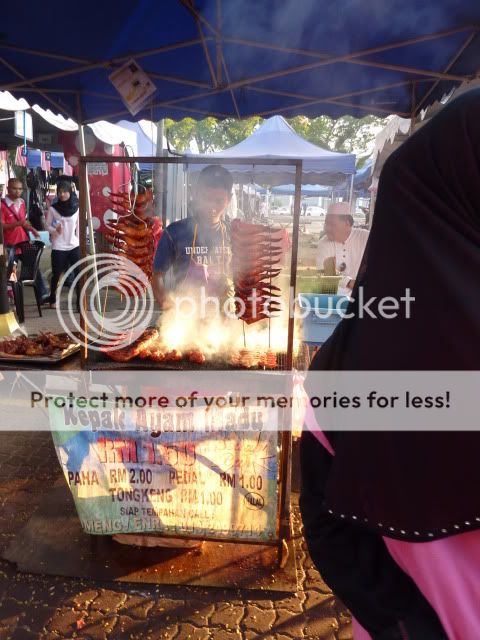
In many places around Kuantan, vendors line up to sell buka puasa (break fast) treats starting around 4pm.  One of the largest concentrations of vendors are those that set up alongside the green sward fronting the State Mosque. Here many varieties of snack items are sold, such as kuih, pancakes, barbequed honey chicken (first photo) and lemang, a sticky rice which is steam cooked inside bamboo tubes (second photo).  Thousands of Kuantan residents visit these snack vendors who make up for the lost revenue from not having breakfast or lunch business.  Some food varieties are only available during the fasting month.

After purchasing their take-out buka puasa fare, Kuantan residents will go some place to wait until the Maghrib prayer call (at dusk) and then break fast before going to the mosque or surau for prayers.  In front of the State Mosque, hundreds gather for prayers which are broadcast outside (third photo).  

Following prayers, the crowd heads out to local hotels and restaurants for lavish Buka Puasa feasts.  The prices of these have been rising rapidly in recent years, and places in Kuala Lumpur, for example, can get away with charging up to RM100-150 per person for the meals.  Since Malay culture stresses family time together, I note that some families will go out and buka puasa together every night during the month at places that may be too expensive the rest of the year.  Thus, it is easy now to see how they can spend 25% more for food during this season.  I know that it sounds strange, but I have often suggested to friends back home, that if they really want to sample Malaysian food, come during the fasting month!

Buka Puasa picnickers outside State Mosque in Kuantan; note the vendor tents to the right.


Saturday, August 28, 2010

Office Life in Cubicle Land

Vacation is over; classes have started; the fasting month is in full swing; we are back to Office Life, as usual.

Office Life is lived out in Cubicle Land, where us ordinary lecturers have small desks demarcated by short wall boards.  Since between 65-70% of lecturers are female, and Malay ones at that, Office Life revolves around issues important to Malay women.  As a male I have really no option but to live in Cubicle Land and try to observe the multitude of unwritten rules about co-existing with Malay women.

Rule #1:  Malay women are conservative.  This means that they do not want a male squeezing into a cubicle with them, i.e., a man must keep his distance.  The rule can be broken, however, if one is a man who relates only to women, kind of like a fly (lalat) who flits from desk to desk bothering the ladies.  Flies can co-exist in this manner due to the non-confrontational nature of culture in Cubicle Land.

Rule #2:  Cubicle Land is a place where recipes can be swapped; new handbags perused on internet shopping sites; and -especially- gossip can be shared.  Whatever you do, however, do not clue the white male lecturer in the cubicle behind you into the latest doings of lalat and his madu.  He will find out, after the fact, months later, prompting a response from the ladies: "What?!  You didn't know??"

Rule #3: As Malaysia has numerous pasar malam (night markets) and pasar pagi (morning markets), it has even MORE pasar pejabat (office markets) whereby colleagues can show and sell any of a variety of items: clothing material (picture above), food, plastic foodware, jewelry, Condo timeshares, houses (yes, brochures of new housing developments are passed around) and etc.  Note: the white guy is usually not interested in these things.

Rule #4:  Cubicle Land is for personal discovery and development.  No, NOT in technical or professional terms, but in personal hygiene, clothing, baby issues, and family affairs.  Copies of Wanita are passed around with great recipes highlighted along with articles on "How to Get Your Husband Prepped for Great S**" (** because this is a G-rated blog afterall).  The internet has been very useful also given the numerous shopping sites, for handbags, jewelry, and baby items.  (Don't get me started on the baby items!)

Rule #5: Get work done??   Hahahahaha....please see Rule #4.

Rule #6:  Food.  Life in Cubicle Land -except for the fasting month- revolves around food.  Many ladies keep tins of snack items at their desks and welcome others to partake.  The fasting month finds order boards at a few cubicles where one can peruse (visually only) and order tins of snacks to be paid for and delivered in the 2-3 days prior to the Ramadan vacation.  Tables where educational material might be found instead hold tins of fruit and stinky sauce (sambal) and crumbly cake and so forth.  Goodness, one can't let education get in the way of eating!

Rule #7:  Cell phone ringtones must be annoying.  Crying babies, Japanese love songs, the Wail of Pontianak: these are all examples of acceptable ringtones.

Rule #8:  Pregnancies are staggered so that there is always at least one pregnant woman in Cubicle Land.  Right now, within 20 feet of my cubicle are three pregnant women.  That is not a lot.  Last year at this time, there were five preggies within 20 feet of me.  My colleagues are mostly in their 20s and 30s, making our Cubicle Land one of the Centers for Reproductive Success in Malaysia.  The women will actually discuss and schedule their pregnancies so as to be able to cover for those out on the 60-day maternity leave.  (I even covered for an engineering colleague last year, taking one of her classes for 8 weeks until she returned from maternity leave).  This fact of the scheduling is largely unknown to men.  (I wish it were unknown to me...sigh.)

Overall, I have enjoyed my time in Cubicle Land.  Malay women are very forgiving (save for I Know), cooperative and collaborative.  Despite the chit-chat noise (and Rule #7), especially in the late afternoon, I can survive and will hold some fond memories of Office Life.